0%

Choosing the best colored contacts suppliers in China requires more than comparing prices or attractive product photos. A reliable partner should show clear quality controls, consistent manufacturing, responsive communication, and realistic delivery information. These details matter. A lens may look vivid in a catalog, yet feel different when sampled or photographed in natural light. Buyers should ask about materials, available prescriptions, packaging, customization, and how product quality is checked between batches. Specific answers are more useful than broad promises.

Supplier selection also depends on the buyer’s market and business needs. A small retailer may value flexible order quantities, while a large distributor may focus on stable capacity and repeatable shades. Requesting samples can help assess color, comfort, fit, and packaging before placing a larger order. Documentation and product claims should be reviewed carefully, with requirements verified for the intended sales market. No supplier is the best choice for every buyer. Even a detailed checklist has limits: a polished website cannot confirm day-to-day production consistency. This guide explores what to compare, which questions to ask, and where careful verification matters most when evaluating Chinese suppliers of colored contacts.
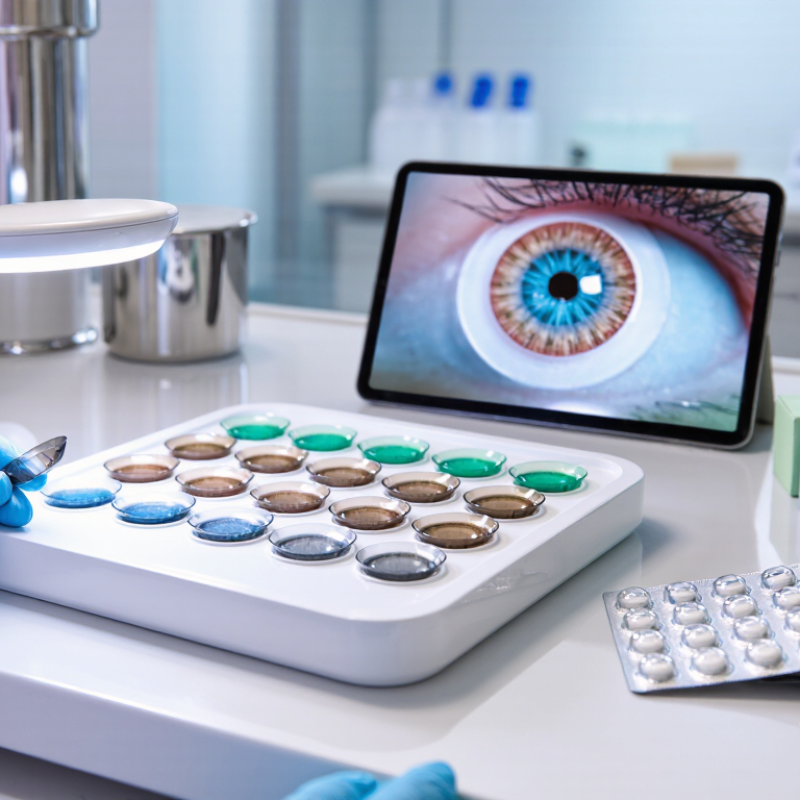
Who Are the Best Colored Contacts Suppliers in China?

What Colored Contact Lens Suppliers in China Provide

Colored contact lens suppliers in China may offer product samples, color collections, and custom manufacturing options. A buyer can compare daily, monthly, or other replacement schedules, where available, alongside lens material, water content, base curve, and diameter. These details affect fit and wearing comfort. Color photos help, but they cannot show exactly how a lens will appear on every eye.

Suppliers may also provide packaging design, private-label production, order quantities, lead-time estimates, and export documents. Ask for current quality records and product specifications, then check that they match the sample and final order. Requirements vary by market, so confirm local rules with qualified professionals. A polished catalog is not proof of consistent quality. Small differences in tint or print can matter. Honestly, comparing samples takes time, and some details may still be unclear until you ask direct questions.

Tips: Request samples from the same production line planned for your order. Check color, edge finish, labeling, and packaging under normal light. Ask how defects are recorded and handled. Keep written specifications; a quick call is easy to forget.

How to Assess Supplier Experience and Product Range

The best colored contact lens suppliers are not identified by catalog size alone. Look for a documented track record in lens manufacturing, quality control, and export support. Ask how long the supplier has handled similar orders, and request examples of batch records, inspection procedures, and product traceability. Clear answers matter. Vague claims about “premium quality” are not evidence. A supplier should explain how it checks lens dimensions, color consistency, packaging, and defects, and how it handles problems after delivery. A spreadsheet can make comparisons look simple; the details rarely are.

Assess the range against your actual needs. Check available shades, opacity levels, lens materials, wear schedules, and parameters such as base curve and diameter. Confirm whether prescription options and sample evaluation are available, and review labeling and product documentation for your market. Small details matter. A wide range may still have gaps in fit or specifications. Ask for samples and compare color under ordinary indoor light, not only polished product photos. I would also check response times and whether technical staff can answer specific questions. Supplier experience is useful, but it does not guarantee every product suits every wearer; lens selection should be guided by an eye-care professional.

Manufacturing Quality and Safety Standards to Verify

When assessing colored contact lens suppliers in China, look beyond polished brochures. Ask for a current quality-management certificate, such as ISO 13485, and confirm its scope covers the factory and product type. A certificate alone is not enough. Check the issuing body and dates, then request relevant test records for the exact lens design, not a similar sample.

Ask how the supplier controls sterilization, packaging integrity, and batch traceability. Request evidence that lens parameters, color consistency, and shelf-life claims are checked and recorded. If testing is outsourced, identify the laboratory and review the report’s methods and sample details. Ask for evidence. A responsible supplier should explain applicable standards, including relevant ISO 18369 methods, without treating a standard as proof of every safety claim.

Colored lenses sit directly on the eye, so comfort claims deserve careful scrutiny. Ask what biocompatibility assessments and risk reviews support the product, and how complaints or quality failures are investigated. Where applicable, verify regulatory documents for the destination market. Details matter. Paperwork can look complete while leaving one awkward gap: does it match the exact model you plan to buy? Inspecting a sample may reveal print defects or rough edges, but appearance cannot establish safety.

Who Are the Best Colored Contacts Suppliers in China? — Manufacturing Quality and Safety Standards to Verify

Evaluation Area What to Verify Evidence to Request Practical Acceptance Check
Regulatory authorization Confirm that the exact colored contact lens product and manufacturing site are authorized for the intended market. In China, contact lenses are regulated medical devices; authorization should match the product, manufacturer, and manufacturing address. Current NMPA registration or filing details, applicable manufacturing authorization, and the product’s approved labeling. Verify the record in the relevant official regulatory database. Check that product names, model or specification, legal manufacturer, and site details are consistent.
Quality management system Check that production and quality controls are managed under a documented medical-device quality system. ISO 13485 certification can support this assessment but does not replace required product authorization. Current ISO 13485 certificate, certificate scope, issuing-body details, audit information, and quality-system procedures relevant to contact lenses. Confirm the certificate is current and covers the actual manufacturing site and relevant activities—not only sales, distribution, or an unrelated facility.
Product specifications and testing Review defined specifications for lens geometry, power where applicable, base curve, diameter, material, and other declared performance characteristics. Ask how measurements are conducted and controlled. Approved product specifications, representative test reports, test methods, equipment calibration records, and lot-level inspection results. Compare test reports with the exact product specification and destination-market requirements. Look for traceable sample identification, test dates, and acceptance criteria.
Material and biological safety Assess the lens material, colorant, printing or tinting process, and any substances that may contact the eye. Biological evaluation should be appropriate to the finished device and its intended use. Material declarations, supplier controls for raw materials, finished-product biological evaluation documentation, and relevant test reports. Check that evidence applies to the finished colored lens, not only an uncolored material or a different product. Review changes to materials and processes.
Oxygen transmission and wear parameters Verify that oxygen-related performance and permitted wear schedule are supported by product-specific evidence and are consistent with the approved labeling. Oxygen permeability or transmissibility test data, lens-thickness information where relevant, and the authorized wearing and replacement instructions. Do not infer suitability for extended or overnight wear from appearance or material claims. Confirm that the labeled schedule is supported by the applicable evidence.
Sterility and microbiological controls For products labeled sterile, review the sterilization process, routine monitoring, and controls that maintain sterility through the stated shelf life. Sterilization validation and monitoring records, microbiological test results, environmental controls, and procedures for investigating failed results. Check that validation covers the actual product and packaging configuration and that routine records are traceable to production lots.
Packaging integrity and shelf life Inspect the primary lens container, seal integrity, packaging materials, storage conditions, and substantiation for the stated expiry date. Packaging specifications, seal or integrity test records, stability data, storage instructions, and sample labels. Confirm that expiry dates and storage conditions are supported by stability evidence for the marketed packaging and product configuration.
Labeling and instructions for use Check that labels and instructions clearly state intended use, wear and replacement schedule, care requirements where applicable, warnings, contraindications, and traceability information. Market-specific labels and instructions for use, controlled revision history, and evidence of regulatory review or approval where required. Confirm the supplied version meets the destination market’s language and labeling rules and matches the authorized product information.
Lot traceability and change control Ensure each finished product can be traced to its production records, raw materials, inspection results, and release decision. Review how changes are evaluated and authorized. Sample batch records, lot-release certificates, traceability procedures, nonconformance records, and change-control procedures. Ask the supplier to trace a sample lot from incoming materials through finished-product release and identify how affected customers are notified of a significant change.
Complaint handling and corrective action Review systems for receiving safety complaints, investigating adverse events, taking corrective action, and supporting recalls or regulatory reporting when required. Complaint-handling procedure, anonymized investigation examples, corrective and preventive action records, and recall or field-action procedure. Check that the process includes timely escalation, documented root-cause analysis, effectiveness checks, and traceability to affected lots.
Independent verification and site audit Assess whether the supplier permits a qualified audit and whether key product claims can be independently checked. Certificates and promotional materials alone are not proof of product quality. Audit access or recent audit findings, laboratory accreditation details where relevant, and reports from competent independent testing organizations. Verify the testing organization and report scope, and confirm that samples represent the product and manufacturing site being evaluated.

Note: No single certificate or test report establishes that a supplier is “best.” Evaluate the exact product, manufacturing site, destination-market requirements, and current supporting records. Regulatory requirements and accepted evidence can differ by market and product type.

Types of Chinese Colored Contact Lens Suppliers

Chinese colored contact lens suppliers generally fall into several distinct groups. Direct manufacturers handle production, inspection, and packaging in their own facilities. They may suit buyers seeking consistent specifications or larger orders. Ask how lens parameters are checked and whether sample lots match later batches. Details matter.

OEM and ODM suppliers offer different levels of customization. OEM services usually follow a buyer’s design, while ODM providers may help develop colors, packaging, or product specifications. Custom work can require higher minimum quantities and longer lead times. Confirm these details before approving a sample. A color that looks subtle in a studio photo may appear stronger under daylight.

Trading companies and wholesale distributors connect buyers with factories or stock products from several sources. They can simplify communication and smaller orders, but buyers may have less direct visibility into production. Request clear product documentation, batch traceability, and written quality procedures. Not always. A supplier’s category alone does not prove reliability; compare physical samples, response times, and inspection records before deciding.

How to Choose a Supplier for Your Market

Choosing a Chinese colored-contact supplier begins with the market you serve, not the lowest quotation. Grand View Research estimated the global contact lens market at roughly US$20 billion in 2023 and projected continued growth. That figure covers contact lenses broadly, not colored lenses alone. Treat it as context, not a sales forecast. A supplier should explain its manufacturing capacity, minimum order quantity, sample process, and realistic lead times. Ask for traceable batch records and quality-system documentation, including relevant ISO 13485 certification and ISO 18369 information. Check which documents apply in your destination market.

Look closely at the details your customers will notice: color consistency across samples, lens comfort information, clear packaging text, and replacement instructions. Request samples from more than one production batch; one attractive sample proves little. It is easy to overvalue polished packaging. No checklist is perfect. Compare defect-handling procedures, response times, and whether the supplier can support your preferred package sizes without changing specifications. Confirm local product registration and labeling requirements before placing an order, since requirements differ by market. A cheap quote may exclude testing, translation, or rework. Put specifications, tolerances, and corrective actions in writing, then review them with a qualified regulatory professional.

Who Are the Best Colored Contacts Suppliers in China? How to Choose a Supplier for Your Market

How to use this chart: These suggested evaluation weights are a planning framework, not measured market statistics or a ranking of suppliers. Prioritize market-specific regulatory documentation and product quality, then adjust the weights to fit your destination market. Verify documentation, samples, quality controls, and lead times directly with each supplier.

FAQS

How can I assess a supplier’s experience?

Ask how long they have handled similar orders. Request batch records, inspection procedures, and traceability examples. Vague quality claims prove little.

What product details should I compare?

Check shades, opacity, materials, wear schedules, base curve, and diameter. A large catalog can still miss your fit needs.

How should I evaluate sample lenses?

Compare samples under ordinary indoor light, not just polished photos. Look for color differences, print defects, and rough edges. Appearance cannot prove safety.

What quality documents should I request?

Request a current quality-management certificate and confirm its scope covers the factory and product type. Check the issuer and dates. A certificate alone is not enough.

How can I verify product testing?

Ask for test records for the exact lens design. Review methods, sample details, and any outside laboratory’s identity. Details matter.

What manufacturing controls should I ask about?

Ask how sterilization, packaging integrity, lens parameters, and color consistency are checked. Request records showing batch traceability and shelf-life checks.

How should safety claims be reviewed?

Ask what biocompatibility assessments and risk reviews support the product. Confirm relevant documents for your destination market. Paperwork may still leave gaps.

Does supplier experience guarantee a suitable lens?

No. Experience helps, but it cannot confirm a lens suits every wearer. An eye-care professional should guide selection. I would still hesitate to judge fit from a sample alone.

Conclusion

Choosing the best colored contacts supplier in China involves more than comparing prices. A dependable supplier should offer a clear product range, including varied colors, designs, materials, and options suited to different customer needs. Assess the supplier’s industry experience, production capacity, communication, and ability to provide consistent specifications and reliable order support. These factors can help you determine whether the supplier is equipped to serve your market over the long term.

Before making a decision, verify the manufacturer’s quality-control processes, product documentation, and applicable safety standards. Chinese suppliers may include manufacturers, trading companies, and specialized exporters, each offering different levels of production control, customization, and service. Compare them based on your priorities, such as product variety, order quantities, lead times, and support. Request samples and confirm requirements in writing to make a more informed choice and build a practical supplier relationship.

Ethan

Ethan

Ethan is a professional marketing specialist with a strong understanding of the company’s products, customer needs, and the practical considerations that shape purchasing decisions. He regularly contributes expert articles to the company website, offering clear, useful insights to help readers......