


Whitepaper: Strategic OEM Sourcing of CE-Certified Yearly Colored Contact Lenses
The global cosmetic contact lens market has undergone a structural transformation. Buyers are no longer seeking simple aesthetics; international optical chains, e-commerce brand owners, and medical device importers require a delicate synergy between high oxygen permeability, biocompatibility, pigment encapsulation, and rigorous regulatory clearance. Annual (yearly replacement) soft colored contact lenses represent one of the most profitable segments in consumer eye care, offering end-users an economical per-day cost while providing brand owners with exceptional customer retention dynamics.
SEO & Procurement Insight: Sourcing annual colored contact lenses requires strict verification of material polymer stability. Lenses intended for 365-day wear cycles must resist protein deposition and maintain optical centration without micro-deformation over time.
1. Material Engineering: HEMA Hydrogel vs. Advanced Silicone Hydrogel
Selecting the optimal polymer substrate is the foundation of any successful OEM private-label optical program. Modern yearly contact lenses predominantly utilize either stabilized Hydroxyethyl Methacrylate (HEMA) cross-linked networks or advanced Silicone Hydrogel (Si-Hy) matrices.
| Technical Parameter | HEMA Hydrogel Series | Silicone Hydrogel (Si-Hy) Series |
|---|---|---|
| Oxygen Transmissibility (Dk/t) | 15 - 25 Dk/t (Ideal for standard daily wear) | 80 - 120 Dk/t (Extended comfort & breathability) |
| Water Content Range | 38% - 42% (Low dehydration rate) | 45% - 55% (High fluid balance) |
| Modulus (Flexibility) | 0.3 - 0.5 MPa (Ultra-soft, quick adaptation) | 0.6 - 0.9 MPa (Enhanced shape retention) |
| Pigment Encapsulation Compatibility | Exceptional color depth & multi-tone stacking | Requires specialized surface hydrophilic coating |
| Target Retail Positioning | Mass-market cosmetic, cosplay, retail fashion | Premium clinical, prescription cosmetic, sensitive eyes |
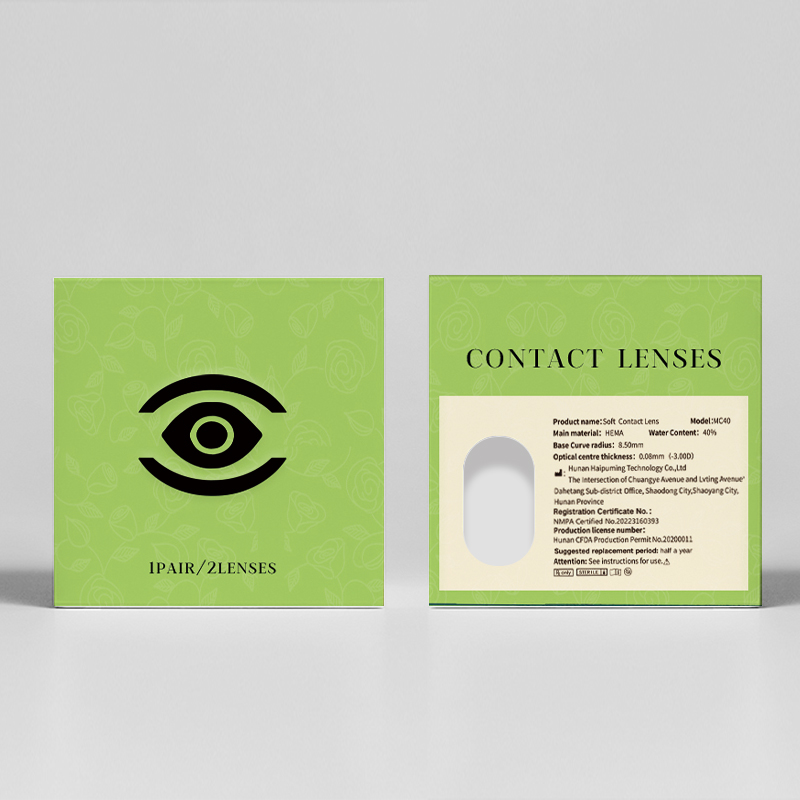
For yearly replacement modalities, a low-to-medium water content (38% to 40%) in HEMA formulations is structurally advantageous. High water content hydrogels tend to draw moisture away from the user's tear film over extended hours, leading to lens desiccation. By maintaining a controlled 38% water content alongside a center thickness of approximately 0.08mm, our manufacturing processes guarantee structural resilience without sacrificing ocular comfort.
2. Pigmentation Science: Double-Cladding Sandwich Technology
Safety is the non-negotiable benchmark of medical-grade cosmetic lenses. Inferior manufacturing techniques utilize direct surface printing, exposing raw bio-pigments to the direct corneal surface and inner palpebral conjunctiva. This risks pigment leaching, surface roughness, and ocular inflammation.
Leading ISO-certified manufacturing facilities implement Sandwich Pigmentation Technology (Embedded Ink Isolation). During the automated cast-molding process, organic bio-colorants are micro-encapsulated between two sterile layers of transparent HEMA hydrogel polymer. The pigment layer never touches the surface of the eye, ensuring a smooth surface profile, reduced friction during blinking, and zero pigment degradation over the 12-month lifecycle.
Quality Assurance Benchmark: Every batch of Colorlenshub lenses undergoes rigorous ISO 10993 cytotoxicity, ocular irritation, and systemic toxicity testing to guarantee full biocompatibility before global export.
3. Regulatory Compliance: Navigating CE, ISO 13485, and Global Registration
Importing cosmetic contact lenses into regulated territories demands exhaustive technical documentation. Under European Union regulations, colored contact lenses—even non-prescription (plano 0.00)—are categorized as medical devices governed by stringent safety directives.
- ISO 13485 Certification: Demonstrates that the manufacturing site operates under a comprehensive Quality Management System specifically audited for medical devices.
- CE Certification (MDD/MDR Compliance): Serves as the golden key for distribution across the European Economic Area, verifying conformity with essential health, safety, and environmental standards.
- SGS Onsite Audits: Third-party verification confirming factory footprint, production capacity, automated inspection systems, and operational workforce authenticity.